





Choosing cable insulation
PVC XLPE rubber and fluoropolymers
Cable insulation affects operating temperature, electrical performance, flexibility, installation conditions and total cost. Two cables with the same 2.5 mm² conductor size can still require different applications and installation methods.
Chinese cable designations such as YJV, KVV and KVVP2 encode construction details, but their letters must be read within the relevant designation system. Insulation, outer sheath, screening and armour are separate features. For international enquiries, state the construction and applicable standard as well as the model code.
This guide compares PVC, XLPE, rubber compounds and fluoropolymers. Temperature figures are typical reference values, not universal ratings for every cable made from that material. Continuous conductor temperature, ambient temperature, installation temperature and short-circuit temperature describe different conditions. The finished cable specification and project requirements govern selection.
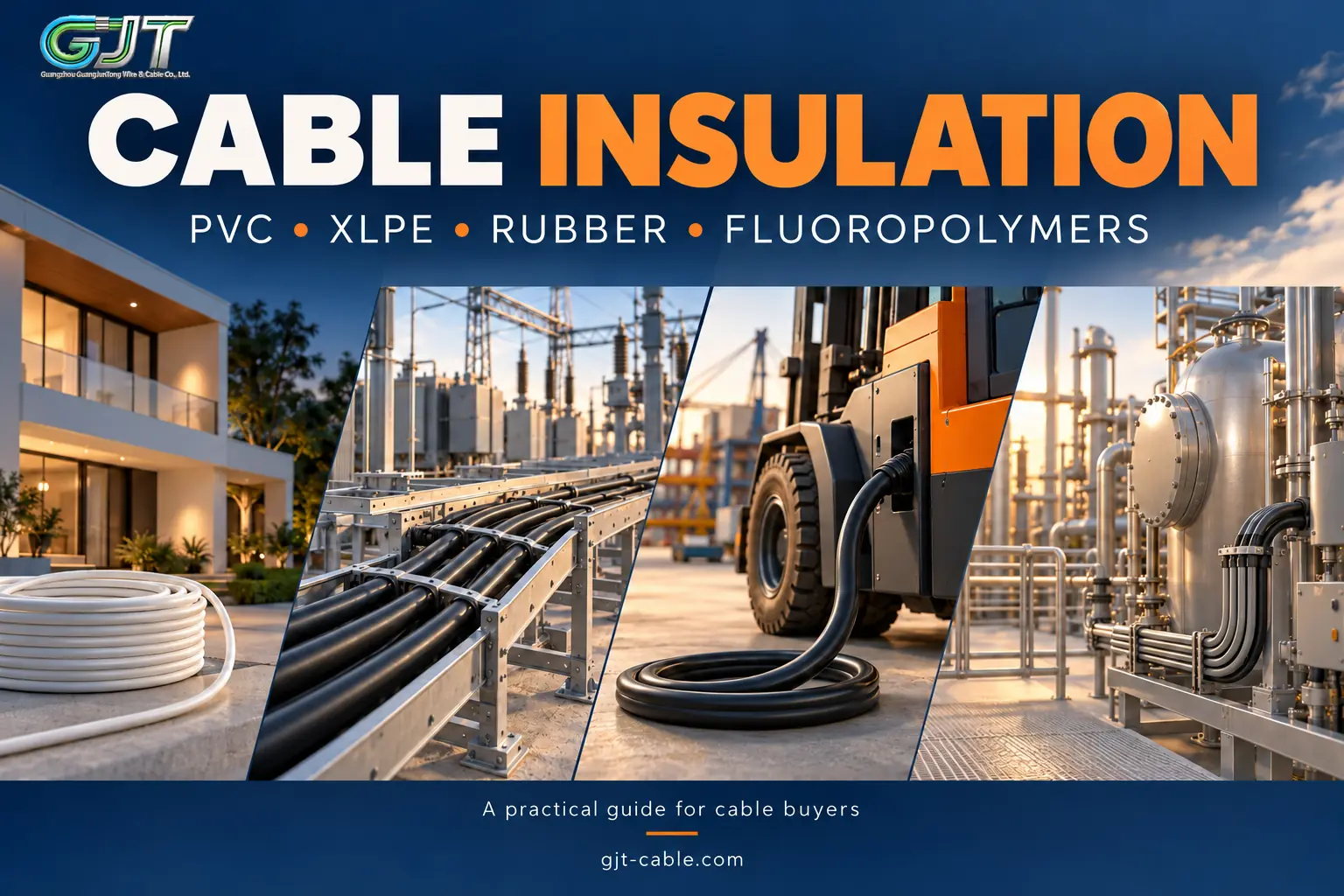
Illustrative application scenes. Temperature and application limits must be checked against the finished cable specification.
PVC for general wiring and cable applications
Polyvinyl chloride is a widely used, economical insulation and sheath material. It appears in building wires, low-voltage power cables, control cables and flexible cords. The conductor and cable construction determine whether a particular PVC cable is intended for fixed installation or flexible service.
Temperature and performance
General-purpose PVC-insulated cables commonly have a 70°C continuous conductor temperature rating. Heat-resistant designs may be rated at 90°C or another specified value. A short-circuit limit of 160°C is common for certain PVC power cables with conductors up to 300 mm²; larger conductors may have a 140°C limit under the relevant standard. These are fault-condition limits, not normal operating temperatures. Permitted duration and fault current must be checked for the actual cable.
PVC is easy to process, offers useful mechanical properties and can be formulated for suitable flame performance. However, flame-retardant performance must be demonstrated by the specified cable test. PVC contains chlorine and can release hydrogen chloride and smoke during a fire. Standard PVC cable is not a low-smoke zero-halogen product.
Typical applications
- Indoor building wiring, including appropriately specified BV and BVR wires.
- Low-voltage power distribution, including VV and VLV constructions.
- Control and equipment connections, including KVV, RVV and other suitable designs.
Selection limits
Check heat exposure, UV resistance, oil resistance and cold-weather installation requirements. Ordinary grades can become stiff at low temperatures, while specialty compounds may have different limits. Where the project requires low smoke, low corrosivity or halogen-free performance, select a tested cable construction meeting those requirements.
Reading the model
In common Chinese BV, BVR, VV, KVV and RVV designations, V identifies PVC insulation or sheathing according to its position. VV commonly describes PVC insulation and a PVC sheath; RVV is a flexible PVC-insulated, PVC-sheathed cable. A letter in a model code is not a complete product specification.
XLPE for fixed power cable systems
Cross-linked polyethylene has a molecular network that improves thermal stability compared with ordinary polyethylene. It is widely used in low-, medium- and high-voltage power cable designs because of its electrical properties, thermal capability and low dielectric losses.
Temperature and performance
A 90°C continuous conductor rating is common. For many specified power cable designs, the maximum short-circuit conductor temperature is 250°C for a duration not exceeding 5 seconds, subject to the applicable standard and fault calculation. There is no single minimum installation temperature for all XLPE cables: the sheath, construction and manufacturer instructions also matter.
A higher allowable conductor temperature can permit higher ampacity under suitable conditions. The improvement is not a universal 10–15%, and a smaller conductor cannot be chosen on insulation type alone. Installation method, ambient or soil temperature, grouping, voltage drop, fault withstand and termination limits all need to be assessed.
Polyethylene itself contains no halogen, but the complete cable may include a PVC sheath or other halogen-containing components. XLPE insulation does not by itself establish low smoke, halogen-free or flame-retardant performance. Specify and verify the complete construction and required tests.
Typical applications
- Fixed distribution feeders and appropriately designed medium- and high-voltage networks.
- Cable trays, ducts, cable trenches and underground routes where the complete cable is rated for that installation.
- Public buildings requiring specified fire performance, using a suitable tested LSZH cable construction.
Selection limits
Ordinary fixed-installation XLPE power cables should not be assumed suitable for repeated flexing, reeling or drag-chain use. Cold-weather suitability must also be confirmed for the complete cable. These are construction and qualification questions rather than blanket exclusions for the polymer.
Reading the model
In common Chinese power cable designations, YJ identifies XLPE insulation. YJV commonly combines a copper conductor, XLPE insulation and a PVC outer sheath. YJV22 adds steel-tape armour with a PVC outer sheath. A designation such as WDZ-YJY identifies an intended low-smoke halogen-free flame-retardant construction within its applicable specification; obtain the actual construction details and test evidence.
Rubber compounds for equipment and power cables
Rubber is a family of elastomer compounds, not one material with one rating. Many rubber cable designs combine flexible conductors with insulation and sheathing selected for mobile equipment, industrial duty or harsh environments. PVC cords can also be flexible, and some rubber-insulated power cables are designed for fixed installation.
Common compounds and reference temperatures
The figures below are broad examples of compound or cable classes. Product ratings can be lower or higher and can change between mobile and protected fixed use. For example, one Nexans H07RN-F range specifies 60°C for mobile service and 85°C for protected permanent installation.
Compound | Indicative reference | Key consideration |
Natural rubber NR | Often around 60°C in general-purpose designs | Elasticity; limited heat and oil resistance |
Styrene butadiene rubber SBR | Often around 60–70°C in general-purpose designs | Compound and cable specification govern |
Ethylene propylene rubber EPR EPDM | Commonly 90°C in suitable cable designs | Used in industrial and power applications |
Nitrile rubber NBR | Often 70–90°C depending on formulation and use | Oil resistance; frequently used in sheath blends |
Silicone rubber SiR | Commonly 180°C; some specified grades differ | Heat resistance; check tear and abrasion resistance |
Some silicone cables specify a fixed-use range down to -60°C, but their flexing limits can be less permissive. Do not apply a -40°C or -60°C claim to every rubber cable. Temperature, oil, ozone and weather resistance depend on the actual compound and cable design.
Typical applications
- Portable tools, construction equipment, welding leads, cranes and temporary power, using the appropriate duty-rated cable.
- Mining, marine and offshore equipment where the cable has the necessary construction, tests and approvals.
- High-temperature equipment wiring using a suitable silicone cable.
- Fixed power systems using specifically designed EPR cables. EPR is also used for medium-voltage utility cables.
Selection limits and model identification
A soft cable is not automatically suitable for continuous flexing, torsion, trailing or reeling. Check bend radius, cycle duty, tensile loading, abrasion and the sheath. Familiar Chinese series include YZ and YC rubber-sheathed flexible cables, MY mining cable families and YG or YGC silicone designs, subject to the relevant specification. Y on its own is not a universal rubber identifier: its meaning changes with the designation system and position.
Fluoropolymers for demanding applications
Fluoropolymers are specialty insulation or sheath materials selected for heat resistance, chemical resistance, electrical performance and compact construction. PTFE, FEP, PFA, ETFE and PVDF have different properties and application limits.
Indicative upper temperature references
Material | Common reference | What to verify |
PTFE polytetrafluoroethylene | Up to about 260°C | Finished cable rating and processing construction |
FEP fluorinated ethylene propylene | Up to about 200°C | Some finished cables have lower ratings |
PFA perfluoroalkoxy polymer | About 250–260°C | Grade and finished cable construction |
ETFE ethylene tetrafluoroethylene | Often about 150°C | Special cross-linked grades can differ |
PVDF polyvinylidene fluoride | Often about 150°C | Grade, cross-linking and application |
Material data and finished cable data can specify different service limits. Use the cable datasheet for selection. A melting point or short-term heat exposure value is not a continuous operating rating.
Many grades offer strong chemical resistance, low moisture absorption and useful electrical performance at elevated temperatures. Verify compatibility with the specific chemical, concentration, temperature and exposure time. Mechanical properties vary: ETFE can offer relatively high toughness, while PTFE needs attention to deformation under load.
Typical applications
- High-temperature instrumentation and control wiring in appropriately designed industrial equipment.
- Chemical process equipment with a verified material compatibility requirement.
- Aerospace, specialty electronics and high-frequency cables designed to the required application standards.
Selection limits
Specialty materials and processing can increase cost, so specify them where their properties solve an identified application need. These polymers contain fluorine and are not halogen-free. Heat resistance does not establish circuit integrity during fire. Emergency circuits require the specified tested fire-resistant cable system and installation. IEC 60331 addresses circuit integrity under defined fire conditions.
Reading the model
Some Chinese specialty designations, including KFF and DJFFP, use F for fluoropolymer insulation or sheathing. For these and AF200, FF46 or other series, confirm the exact polymer, voltage and finished cable temperature rating from the applicable specification. One letter alone does not identify every resin.
A practical selection checklist
Start with the application, then compare cable constructions that meet the same requirements. Before asking for a quotation, confirm:
- Rated voltage, conductor material, core count and nominal cross-sectional area.
- Load current, installation route, ambient or soil temperature, grouping and termination limits.
- Fixed, occasional movement, continuous flexing, torsion, trailing or reeling duty.
- Exposure to oil, chemicals, moisture, sunlight, abrasion and low temperatures.
- Required flame propagation, smoke, halogen or circuit integrity tests, plus local approvals.
- The exact product datasheet, test scope, packaging, length, quantity and delivery requirements.
GJT Cable enquiries
WhatsApp: +86 180 5426 1356
Email: trade001@gjt-cable.com
Website: https://gjt-cable.com/
Temperature values in this guide are educational references. The cable standard, manufacturer data and project design determine the permissible operating conditions.